- TANISHA
- No Comments
# UPI MDR 2026 Explained: What Is Merchant Discount Rate and Why Is It in the News?
# UPI MDR 2026 Explained: What Is Merchant Discount Rate and Why Is It in the News?
## Introduction
UPI has become one of the most common ways to make digital payments in India. From small shops to large businesses, millions of people use UPI every day.
But now, a new term is getting attention: *MDR — Merchant Discount Rate*.
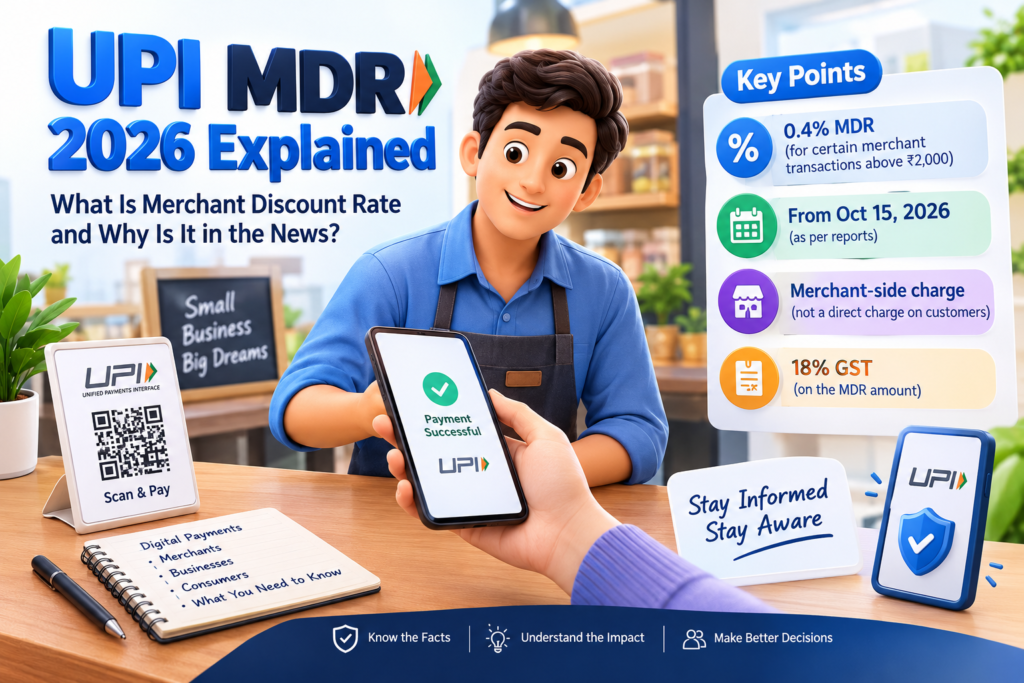
Reports about a proposed *0.4% MDR on certain UPI merchant transactions above ₹2,000* have created discussion among businesses, retailers and other stakeholders.
So, what exactly is MDR? Who may have to pay it? Will customers also be charged? And why has this issue become important?
Let’s understand the UPI MDR issue in simple language.
## What Is MDR?
*MDR stands for Merchant Discount Rate.*
It is a fee associated with processing a digital payment made to a merchant.
In simple words:
*MDR = A payment processing charge associated with certain merchant transactions.*
MDR is not the same as a tax on the customer.
The charge is generally connected with the merchant side of a payment transaction and the payment ecosystem involved in processing it.
## What Is the New UPI MDR Issue?
According to recent reports, a new MDR framework is expected to apply from *October 15, 2026*, for certain UPI transactions above ₹2,000.
The reported rate is *0.4%*, with a cap of ₹300 for applicable transactions. There are also different fee arrangements for some categories of transactions.
The issue has attracted attention because UPI has traditionally been widely used for low-cost digital payments.
## Does MDR Apply to Every UPI Payment?
*No.*
The reported framework concerns specific *merchant transactions*, particularly transactions above the specified threshold.
A normal person-to-person UPI transfer is different from a person-to-merchant payment.
For example:
* Paying a friend through UPI → Person-to-person payment
* Paying a shop through UPI → Person-to-merchant payment
* Paying a business for a product or service → Merchant transaction
Therefore, people should not assume that every UPI payment will automatically have an MDR charge.
## Will Customers Have to Pay MDR?
The reported MDR is a *merchant-side charge*, not a direct charge on customers for making a UPI payment.
However, there is a separate question about whether some businesses may try to recover payment-related costs through their pricing.
That is why the issue is being discussed not only by payment companies but also by retailers and business associations.
## Why Are Businesses Concerned?
Some retailers and industry associations have raised concerns about the additional cost.
Businesses often operate with limited profit margins, especially in competitive retail sectors.
Industry groups have argued that even a small percentage fee can increase costs when a business processes a large number of high-value digital transactions.
For example, suppose an applicable transaction is:
*₹10,000*
At an MDR rate of *0.4%*:
*₹10,000 × 0.4% = ₹40*
So, the reported MDR would be ₹40 before any applicable tax.
The actual amount and treatment can depend on the applicable transaction category and rules.
## What About GST on MDR?
Another part of the discussion is *GST on the MDR amount*.
Recent reports say that an *18% GST* may apply to the MDR charge.
Importantly, GST would be calculated on the MDR amount rather than on the entire UPI payment.
For example:
* UPI payment: ₹10,000
* MDR at 0.4%: ₹40
* 18% GST on ₹40: ₹7.20
* Total MDR-related cost: ₹47.20
GST-registered businesses may be able to claim eligible input tax credit according to applicable GST rules.
## Why Is This Becoming a Controversy?
The MDR issue has generated different views.
### 1. Concerns From Retailers
Retail associations have raised concerns that MDR could increase the cost of accepting digital payments, particularly for businesses with small profit margins.
### 2. Questions About UPI Costs
UPI requires a large digital infrastructure involving banks, payment service providers and technology systems.
The discussion therefore also includes the question of how the long-term costs of maintaining and developing the UPI ecosystem should be supported.
### 3. Political Debate
Political parties and leaders have also commented on the issue.
For example, the NCP (SP) has demanded withdrawal of the reported 0.4% MDR, arguing that it could put pressure on small traders.
Other political voices have presented different views about the proposed framework.
These are political positions and should be distinguished from the underlying facts of the MDR proposal.
## Will Small Businesses Be Affected?
The impact may differ depending on the type and volume of transactions a business receives.
Recent reports citing NPCI’s explanation say that a large majority of UPI person-to-merchant transactions are below ₹2,000, while the proposed MDR would focus on specified higher-value transactions.
This means the effect will not necessarily be the same for every merchant.
Businesses should check the rules applicable to their payment category rather than assuming that the same charge applies to everyone.
## What Does MDR Mean for UPI Users?
For ordinary UPI users, the most important point is:
*Do not assume that sending money through UPI automatically means paying an MDR charge.*
The reported MDR framework is related to specified merchant transactions.
Consumers should also be careful if a merchant asks for an additional “UPI charge” and should understand what the charge is for before paying it.
## MDR Example in Simple Language
Imagine you purchase a product worth *₹5,000* from a merchant.
If the transaction falls under the reported 0.4% MDR category:
*₹5,000 × 0.4% = ₹20 MDR*
If 18% GST applies to that MDR:
*₹20 × 18% = ₹3.60 GST*
The MDR-related amount would therefore be:
*₹20 + ₹3.60 = ₹23.60*
This example is only for understanding the calculation; the actual charge depends on the applicable rules and transaction category.
## Why Is UPI MDR Important?
UPI has played a major role in India’s digital payment ecosystem.
Any change in the cost structure can therefore affect:
* Small retailers
* Large businesses
* Payment service providers
* Banks
* Consumers
* Digital payment infrastructure
That is why the MDR discussion is important beyond just one payment.
It is also a discussion about how India’s digital payment ecosystem can remain accessible while supporting the cost of operating and maintaining payment infrastructure.
## What Should Consumers and Merchants Do?
Instead of relying on social media posts or forwarded messages, users and businesses should check the latest official information and applicable payment rules.
Merchants should:
* Understand whether their transactions fall under the MDR framework.
* Check the applicable rate.
* Understand GST treatment.
* Ask their acquiring/payment provider for clarification.
* Keep proper transaction records.
Consumers should:
* Check the amount before completing a payment.
* Understand any additional charge requested by a merchant.
* Keep payment receipts.
* Use trusted payment applications.
## Conclusion
The *UPI MDR issue of 2026* is about how certain merchant transactions may be charged under a reported new Merchant Discount Rate framework.
The reported framework includes a *0.4% MDR for specified UPI merchant transactions above ₹2,000*, with different arrangements for certain categories, and an 18% GST issue related to the MDR amount.
The issue has attracted attention because businesses are concerned about transaction costs, while the broader discussion involves the cost of maintaining India’s rapidly growing digital payment ecosystem.
For consumers, the key point is that *MDR is not simply a charge on every UPI payment*.
### Stay Informed About Digital Payments
Digital payments are becoming an important part of everyday life.
*Before believing a viral claim, understand what MDR means, check the applicable rules, and use reliable information.*
Stay informed. Stay aware. Keep your digital payments secure